Labour Practices in the Rubber Industry
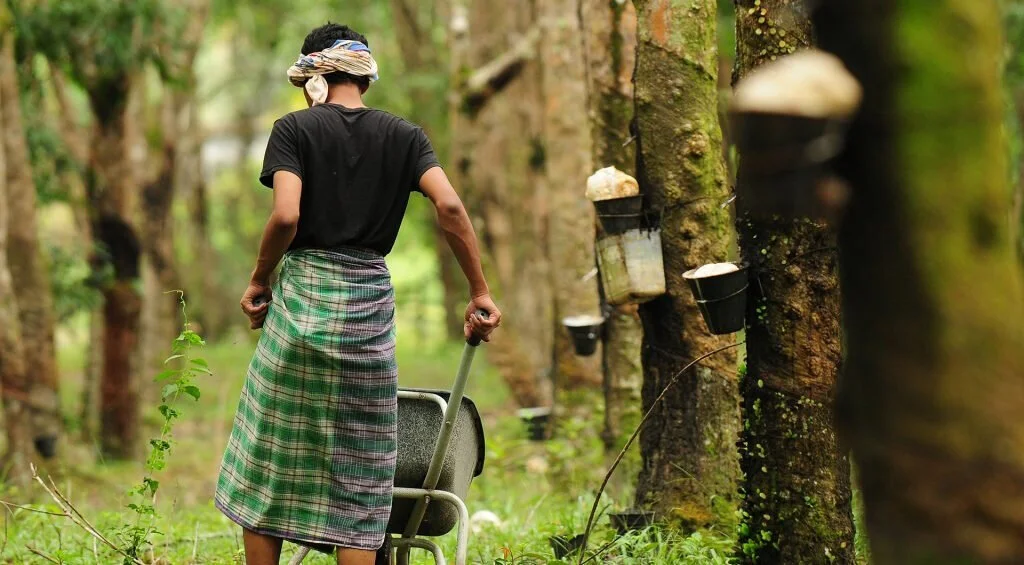
The global trade in natural rubber is beset by poor working conditions and unsustainable practices. Most rubber continues to be harvested by small, locally owned plantations. The rubber tappers are paid by quota, without modern labour protections like minimum wage or worker safety standards. The work is dangerous: tappers are subjected to injury, ranging from machete wounds and snakebites to acid burns received during processing.
The U.S. Department of Labor's most recent List of Goods Produced by Child Labor or Forced Labor includes rubber from Cambodia, Indonesia, Liberia, Myanmar (Burma), the Philippines, and Vietnam. In Myanmar specifically, the report finds children as young as nine have been forced to work rubber nurseries and plantations for the military, with local officials and the armed forces increasingly involved since the 2021 military coup. The list, updated in 2024, added observations of forced labour among migrant workers, mostly from Bangladesh, India, Myanmar, and Nepal, in Malaysia's rubber glove factories, demonstrating how these problems extend from the plantations into downstream manufacturing.
For years, these abuses were widely attributed to a slump in rubber prices following their 2011 peak, which squeezed smallholders into cutting corners on safety and wages. That picture has since shifted. Natural rubber prices have climbed, driven by a supply shortfall: production has lagged demand, ageing trees are not replaced because replanting takes years to pay off, and tappers are leaving (when they can) for better-paying, less physically punishing work in construction, seafood processing, and palm oil. The result is a labour shortage on top of the existing labour abuses. Plantations now compete for workers even as buyer consolidation keeps their margins thin and price volatility keeps their incomes unpredictable.
Rubber is still mostly grown, harvested, and processed by smallholders — more than 85% of the world's supply — who sell globally through brokers. Because the rubber is cured with acid on-site, its country of origin can be difficult to trace. Even so, investigations have repeatedly turned up connections between labour abuses and some of the industry's largest buyers.
The most notorious historical case remains Firestone's plantations in Liberia, where the company relied on child and forced labour for years and continued operating in collusion with warlord Charles Taylor through that country's civil war (1989–2003). Liberia's rubber sector still appears on the Department of Labour's child labour list today.
A decade ago, Global Witness documented how international financiers helped two Vietnamese rubber companies acquire land in Vietnam, Laos, and Cambodia in ways tied to local land grabs. More recently, the Myanmar military has seized land from Rohingya Muslims for rubber cultivation. These and similar cases have led regulators to start building traceability requirements directly into law rather than relying on voluntary disclosure.
The clearest example is the European Union's Deforestation Regulation (EUDR), which took effect in 2023 and explicitly covers natural rubber alongside cattle, cocoa, coffee, palm oil, soy, and wood. Once in force, it will bar rubber-containing products from the EU market unless companies can prove the rubber wasn't grown on land deforested after the end of 2020 — a serious lift for an industry supplied by millions of smallholders with no formal land records. The rule has already been delayed twice amid industry pushback over readiness; large traders and manufacturers are now expected to comply by the end of 2026, with small businesses given until mid-2027. Whatever the final timeline, it marks the first time deforestation-linked rubber sourcing carries real legal consequences in one of the industry's biggest markets, and it's pushing companies and platforms like the Global Platform for Sustainable Natural Rubber (GPSNR) to build the traceability systems that voluntary schemes couldn't get built on their own.
The Fair Rubber Association (FRA) remains one of the more direct ways this gets addressed at the producer level. It brings together NGOs, suppliers, and buyers around a fair trade premium paid to plantations and tappers, with producers themselves deciding how the money is spent and independent auditors verifying compliance at FRA's expense. The current standard, updated in early 2025, added a formal deforestation criterion of its own, ahead of the EU rule taking full effect. FRA currently works with supplier partners in Sri Lanka, India, Thailand, Indonesia, and Malaysia, and reports that its premium has become a meaningful source of income for rubber tappers in Indonesia in particular.
Major buyers have room to do more. Tire makers and other large rubber users can refuse to source from producers or regions implicated in land seizures or forced labour, and can back that up with the kind of on-the-ground traceability that EUDR and GPSNR are now pushing the whole industry toward.
If you want to get involved, you can write to companies that use rubber in their products, look for the FRA logo when you're buying, or join the Fair Rubber Association or one of its initiatives.